In the midst of the growing season, we sat down with our Director of Vineyard Biology & Biodynamic Specialist, Thijs Verschuuren, to talk about Biodynamics. In this interview, he shares how our Biodynamic journey began, what the work looks like day to day, and how these practices continue to influence the health of our vineyards and our wines.

Thijs Verschuuren, Director of Vineyard Biology
Why Biodynamics?
At its core, Biodynamics is regenerative, self-sustaining farming. It emphasizes looking beyond the vine itself and considers the entire farm– not as a collection of separate pieces but as one interconnected system. We don’t think of the vineyard as rows of vines surrounded by empty space. Cover crops, pollinator plants, birds, insects, sheep, and native vegetation all play a role. The goal is to encourage balance. Biodiversity promotes health which helps the vineyard become less dependent on outside inputs. Instead, we build fertility through compost, teas, and natural preparations.
Biodynamics aligns naturally with how we think about farming and stewardship. This is where we live, work, and raise our families, so our goal is not simply to grow grapes, but to care for the land in a way that leaves it healthier for future generations. Ultimately, Biodynamics comes down to respect—for the land, the water, and the people connected to it.
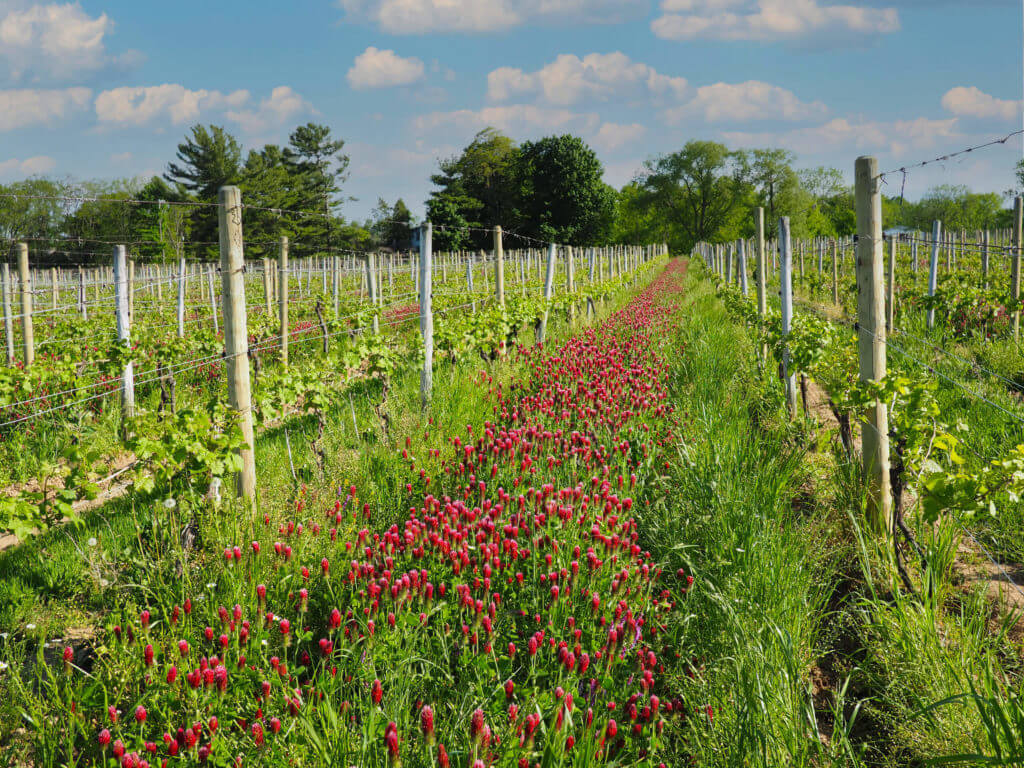
Crimson clover cover crops amongst Riesling
How did Biodynamics become a part of the Hermann J. Wiemer Vineyard story?
In 2015, we established a trial block, HJW4, to study Biodynamic farming while continuing to farm the rest of the property organically. The results became especially clear during the 2018 growing season. That year brought significant disease pressure from warm, wet conditions, yet HJW4 consistently produced cleaner fruit than surrounding blocks.
Our goal isn’t maximum production. It’s creating consistent vineyards that can produce expressive fruit for decades rather than optimizing for a single vintage.
Can you talk about how Biodynamics relates to lunar cycles and their impacts on farming?
Biodynamics asks you to pay attention to rhythms and timing—the relationship between the earth, the moon, the planets, the seasons, and the vine itself.
One of the central ideas is that these cycles correspond to different aspects of plant growth. We, like many Biodynamic growers and producers, use Maria Thun’s sowing calendar, which organizes those influences into root, leaf, flower, and fruit days.
In practical terms, we may schedule certain vineyard activities around those rhythms. Root days might be preferred for planting or pruning, while fruit days are often favored for harvest. There are also periods when we try to avoid major vineyard work altogether.
We don’t approach Biodynamics dogmatically. We approach it with curiosity and humility. Some aspects are easier to explain scientifically than others. At the end of the day, Biodynamics often comes back to something very practical: paying attention, respecting timing, and working with a place rather than against it. What matters most is whether the farm becomes healthier and more resilient over time.
I know Biodynamics is more commonly used on the West Coast. How do we tailor it to our needs in the Finger Lakes?
One of the strengths of Biodynamics is that it is not tied to a specific climate. Instead, it encourages you to work closely with the conditions of your own site and region. That approach feels particularly relevant in the Finger Lakes, where every season brings its own challenges and opportunities.
I always like to use the example of sheep in vineyards. In climates that are consistently warm and dry, sheep are typically brought in during the winter and early spring to clear cover crops and grass before the growing season kicks off at budbreak, but are less crucial in the summer, when vineyard floor growth slows.
Here in the Finger Lakes, they arrive later in the spring and often remain throughout the summer because the grass and cover crops never really stop growing. The land is wetter and grows rapidly, so the sheep help graze the vineyard, reducing tractor passes, compaction, diesel usage, and man-hours. Of course, sheep are only one piece of the puzzle. Their role isn’t simply vineyard maintenance. They contribute fertility and help complete the cycle of the farm.
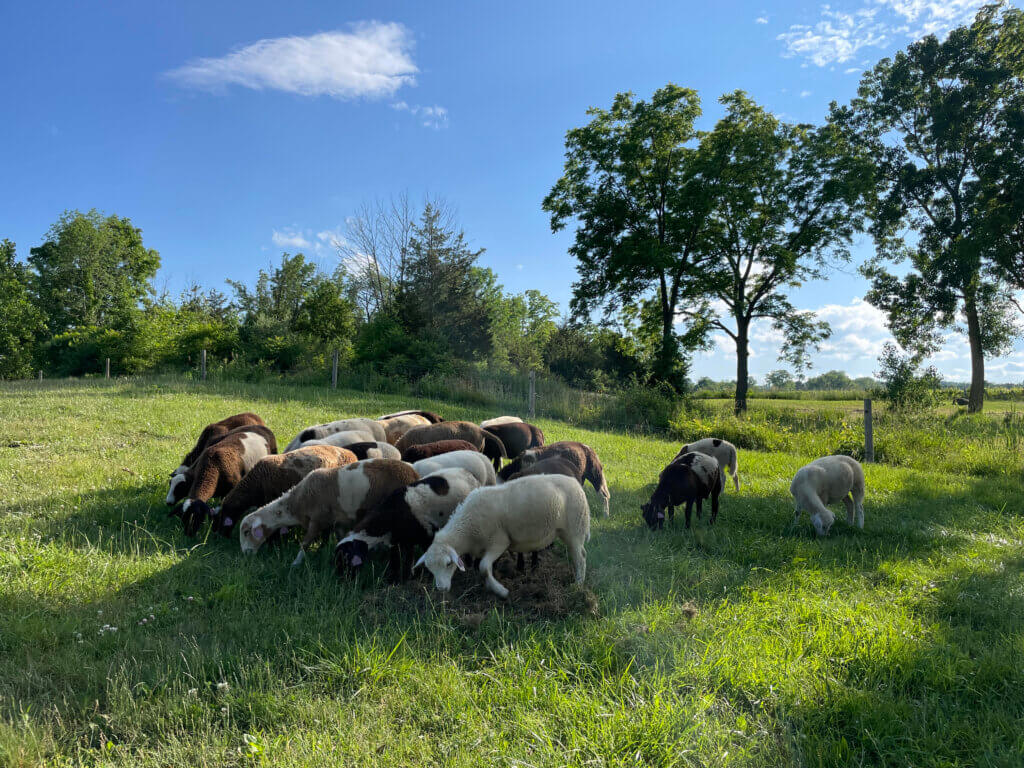
Sheep at our HJW Vineyard
Tell me about the efforts toward Demeter certification at our Standing Stone site.
This year marks the beginning of our transition toward fully biodynamic farming at Standing Stone. It’s the first step in a multi-year journey toward Demeter certification. Standing Stone is one of the most historic vineyard sites in the Finger Lakes, and we want to honor that by improving the long-term health of the farm and its soils. We’re starting with the soil, focusing on compost-based fertility, cover crops, and a tea-based spray program informed by what we’ve learned over time at HJW.
Are there unique challenges at the Standing Stone site compared to HJW?
Absolutely. The two sites are very different.
HJW has more shale-based shallow soils. Despite the shallow soils, organic matter levels are high, indicating a healthy soil system. Standing Stone, by comparison, has deeper soils and naturally higher vigor in many sections of the site.
The eastern side of Seneca Lake also creates different growing conditions. At HJW, the morning sun dries moisture from the canopy relatively quickly. At Standing Stone, that moisture can linger for an hour or two longer, which creates additional pressure from powdery mildew. Because of that, vineyard observation becomes especially important, and, as such, we are growing our team, allowing me to spend more time at Standing Stone to better understand how each block responds throughout the season.
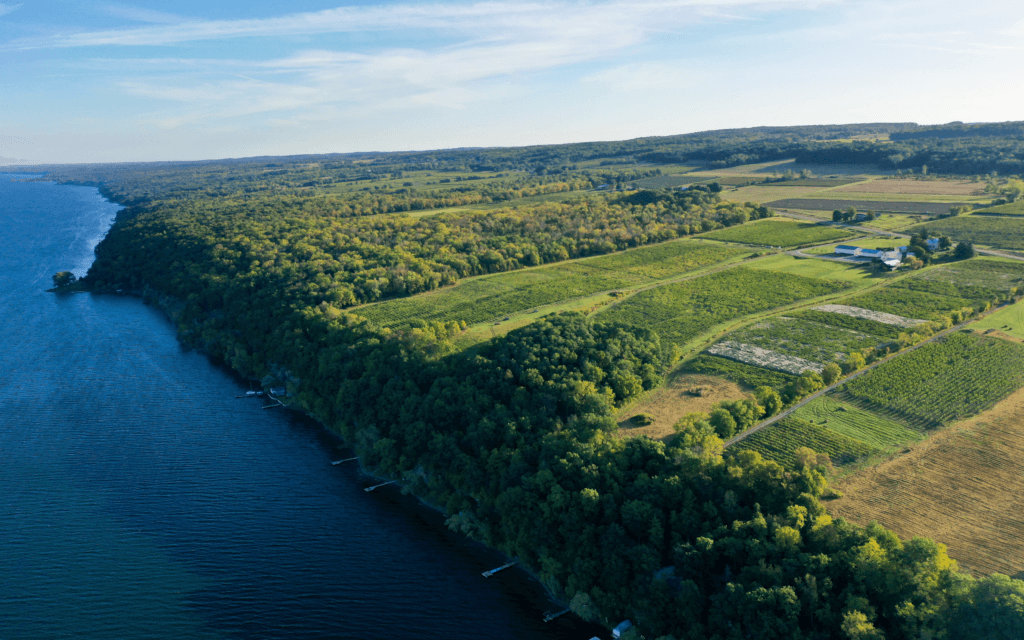
Standing Stone on Seneca Lake
What does a Biodynamic spring look like?
The vines themselves wake up just as they would in any vineyard. Biodynamics begins to show itself in everything happening around the vines, beginning on the vineyard floor.
Right now, if you walk through HJW1, you can already see the cover crops and crimson clover. As the soil warms, everything responds together — the vines, the clover, the insects, and suddenly the bees begin to return. We already have honeybees and bumblebees moving through the vines, which tells you a great deal about what’s happening in the vineyard.
Specifically for spring, the two preparations we use are BD 500 and BD 501. BD 500, often referred to as Horn Manure, is applied first. Cow manure is packed into cow horns and buried throughout the winter months. During this time, the material transforms into something rich, earthy, and biologically active. Then in the spring we unearth it and stir it into water, to create a spray that we then apply to the soil. This stimulates root activity and encourages underground microbial life and promotes soil health
BD 501, or Horn Silica, follows afterward. Where BD 500 focuses beneath the vine, BD 501 works above ground, helping regulate leaf growth, supporting photosynthesis, and enhancing the overall quality and expression of the fruit.
The order of these preparations is important. You begin by building soil vitality, then support the above-ground growth that follows. Together, they help the vineyard prepare for the growing season ahead.
The summer solstice is this weekend. What does it represent in terms of changes in the vineyard?
The summer solstice is the longest day of the year and, in many ways, the halfway point of the farming season.
For me, it’s a celebration of nature and a reminder that we are only one part of it. No matter how much planning or work goes into farming, nature always has the final word. The weather and the seasons ultimately decide what kind of year it will be.
That day is a good reminder to respect that reality and remember that we are working within nature, not controlling it.
Looking towards the fall and harvest, how does biodynamics change the way we work with fruit once it reaches the press pad and cellar?
The winemaking itself changed very little with the transition to Biodynamic farming. We were already very much aligned with and practicing the same principles within the cellar. We ferment with native yeasts, don’t adjust or use additives, and add sulfur only before bottling within Demeter parameters.
The only adjustment was on the administrative side: certified and non-certified fruit must remain separate throughout the process, requiring careful planning, labeling, and tank management. As usual, cleanliness is of the utmost importance, and we do so without harsh chemicals.
What effect do Biodynamic practices and farming have on our wines?
That is ultimately a question for the people drinking the wine. At the end of the day, we prefer not to influence people too heavily with tasting notes or expectations. Wine remains deeply personal, and everyone experiences it differently.
What I can say is that after nearly a decade of Biodynamic farming, we have observed meaningful changes in both the vineyard and the cellar. The vineyards themselves appear more resilient, fermentations tend to be more consistent, and the fruit often develops greater complexity and texture.
For me, the clearest examples are our HJW Single Vineyard wines. They reflect what makes the Finger Lakes unique—cool climates, warm summers, and long autumns. Over time, Biodynamic farming has helped us better express those site-specific characteristics, and hone in on wines that taste, to us, like the Finger Lakes.
What else would you like for people to understand about Biodynamics and our relationship to it?
Transparency and education are incredibly important to us. That’s one reason we continue to offer vineyard and farm tours at both HJW and, increasingly, at Standing Stone. We want people to see not only the successes but also the challenges and realities of this work.
For us, Biodynamics has never been about following a philosophy for its own sake. The goal is always to observe, adapt, and share what we learn with others. We don’t pretend to know everything about Biodynamics. Agriculture has always contained a degree of mystery. There are aspects we can measure scientifically and others that are based more on experience. We’re comfortable with that. We don’t claim to have all the answers, but we remain curious.
One of my goals is to simply encourage more conversation about Biodynamics in the Finger Lakes. Farming has always been rooted in community—sharing ideas, helping neighbors, and learning from one another. That spirit already exists strongly here, which is one of the things I appreciate most about this region. If our experiences can contribute something useful to that conversation, then I think that’s a good thing.
Thank you Thijs for your insight in the Biodynamic program!
For a more hands on perspective on what our vineyard practices are like join for a Farm Tour this summer! Look at available dates here: Summer Farm Tours