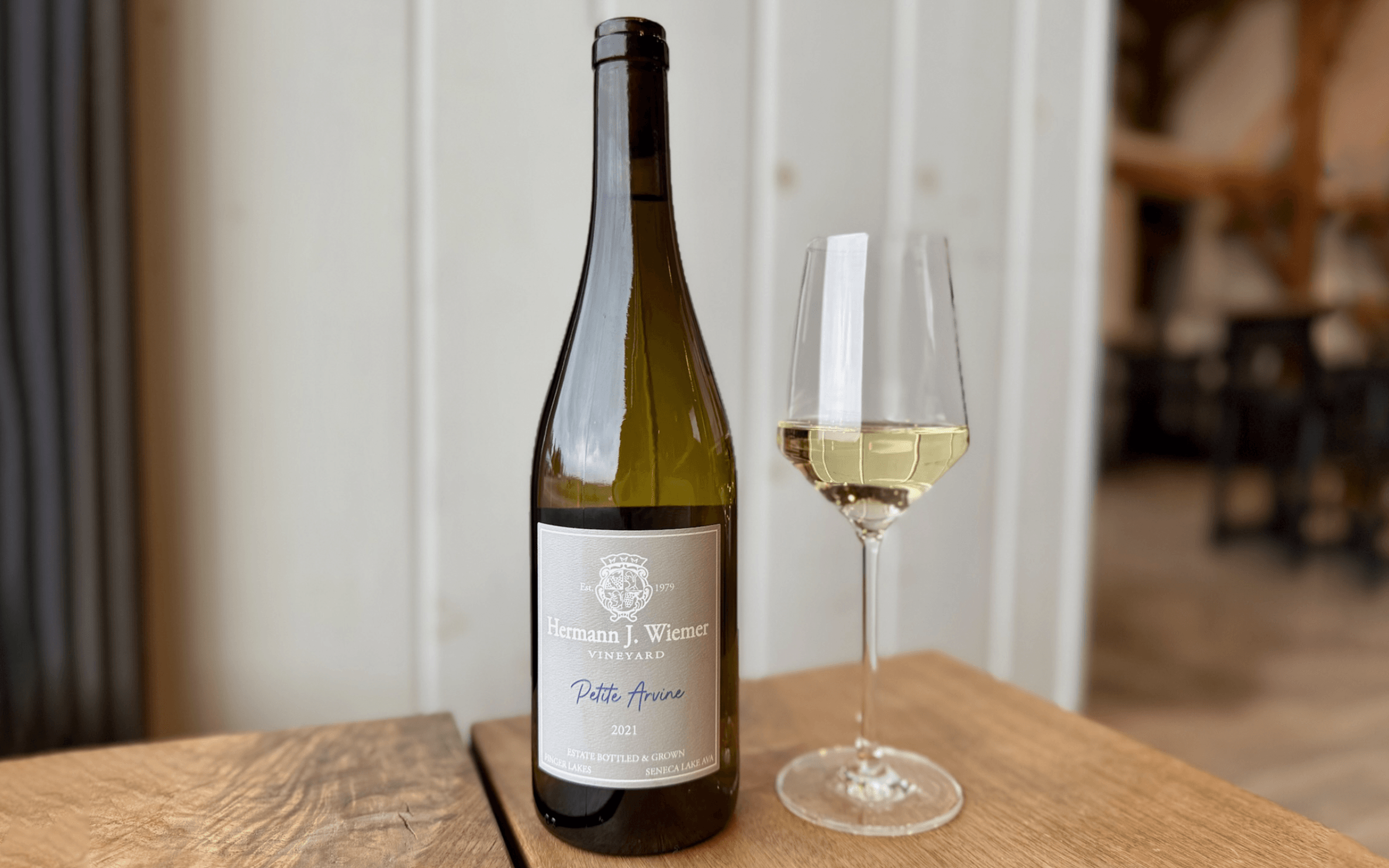
In anticipation of our first release of Petite Arvine, Maris Garden, from our marketing and wine education team, sat down with Head Winemaker/Co-Owner Fred Merwarth to get the story about how and why we began working with this variety, and where it is headed.
Maris: How did Hermann’s nursery work influence the creation of Julia Vineyard?
Fred: Hermann believed in not just accumulating the best plant material possible, but also in observing it, as a way to develop a deep understanding of the viticulture of the Finger Lakes. His work in our Nursery was foundational in determining what varieties would be successful here. And, if you look at how the wine world has evolved over decades and centuries, a region gravitates towards varieties that are proven successful over time. It takes a lot of trial and error to get to that place, and this work that Hermann started felt especially important for us to continue as we looked toward a future where our viticulture would be continually influenced by climate change.
Maris: Where does the name Julia come from?
Fred: Julia is a name from my family. It represents our family’s connection to agriculture across many generations and a look toward the future, as it is our daughter’s middle name. That felt appropriate for a site focusing on both traditional and future cultivars in the Finger Lakes. Besides, anyone who knows our daughter also knows she pushes boundaries, so the namesake seems to be holding up.
Maris: How did you go about deciding what to plant in Julia?
Fred: Let’s see… Three things come to mind, although there are probably more: the classics the industry relies on, the “forgotten” varieties, and varieties with the durability the industry may need as growing conditions become more challenging. By challenging, I mean changing growing conditions, bigger temperature fluctuations, and overall more accentuated weather phenomena.
With that in mind, for me, this process really starts by asking questions: “What’s cold-tolerant and late-budding? Is this something that’s resilient to disease pressures like mildew and botrytis? Can it reach similar quality levels as it does in their home soils? Does it differentiate itself from our traditional varieties, such as Riesling, Chardonnay, and Cab Franc?”
As we were doing research, we recorded and cross-referenced those factors, and then a short list of potential varieties emerged
Maris: When did Petite Arvine first enter the Julia Vineyard conversation?
Fred: I had become friends with Will, the manager of Rosenthal Wine Merchants in New York, and I went to talk with him about the cool-climate varieties we were considering for Julia Vineyard. I was trying to select wines that were both representative of the variety and expressive across vintages. We tasted examples of Jacquère, Erbaluce, Arvine, Savagnin, Romorantin, and Petite Arvine.
I brought the wine, and Oskar gathered his “brain trust” of NYC sommeliers—Pascaline Lepeltier, Lisa Granik, Tom Gannon, Dustin Wilson, Aviram Turgeman—along with a few friends of ours and Hermann’s. We tasted all these potential varieties, comparing their structure, acidity, and aromatic profiles. That tasting helped confirm some of the theories about not only the high quality that Petite Arvine can achieve, but also its viability in the Finger Lakes.
Maris: Why did Petite Arvine stand out?
Fred: My question after the dinner was… [Fred laughs] “Have any of these knocked your socks off?”
I got a lot of feedback from the group; Petite Arvine was the most talked-about, and the group was really excited. It achieves very high ripeness while maintaining its acidity. The Petite Arvines that I’ve tasted over the years have been very complex and intriguing…
Maris: How did you get Petite Arvine plant material, and when did you put it in Julia?
Fred: [Pauses] That’s probably a story best suited for another day, but the short version is that plant material can take anywhere from 2–7 years to arrive. It has to come from Europe, go through quarantine, and then be certified before planting. We worked with UC Davis to source Petite Arvine, which we received and ultimately planted in 2016.
Maris: Can you tell us about the first vintages of Julia Field Study wines?
Fred: After years of acquiring plant material, grafting, planting, and waiting for the young vines to mature, the first clusters finally emerged in 2019. The inaugural Julia wines were produced in 2020. We harvest and ferment each variety individually before blending, which gives us an opportunity to study its character in both the vineyard and the cellar. We look at the varieties and wines individually, and then explore their harmony with one another. That exploration turned into our Julia Field Study wines.
Maris: What led you to make the first Petite Arvine bottling rather than keep it a component of the Julia Field Study White?
Fred: [Laughs] Well, to be honest, it came down to having enough fruit to fill a larger barrel, which meant we could produce enough volume to bottle on its own. Petite Arvine had already proven itself in the vineyard, producing consistent yields with strong quality—even from relatively young vines.
Maris: How would you describe the wine?
Fred: It has great balance, a typical combination of floral and fruit aromas, with driving acidity that is reminiscent of Riesling in intensity, but structured more like Chardonnay. It’s worth remembering that this wine is from relatively young vines, which is why the midpalate is a bit light. But it shows complex and rich fruit with bright acidity, which is driving the train. As the vines age, the wines produced will gain power while retaining a backbone of acidity. The finish is likely a little shorter than it will be once the vines are older, but I am looking forward to the potential it holds to gain intensity, and that’s really what this whole project is about.
Maris: What gave you the confidence to plant Petite Arvine at Standing Stone?
Fred: After several vintages working with the variety in Julia, the next question became where else it might thrive. So, in 2021, we planted it at HJW. It has struggled a bit there. I think it’s because of the soil. But then, in 2023, we ripped out a block of Vidal Blanc at Standing Stone. I thought, “Man, this is a beautiful hillside; this site should have something that we are really forward-thinking on.”
That felt like the natural place to plant Petite Arvine. A hillside with good airflow, lighter and better-drained soils, and lots of exposure. If it’s going to ripen and show a comparable level, Standing Stone is a great place to start. Over time, we have slowly added to it; we are currently at 1.8 acres. We still have an acre and a half to plant.
Maris: What is your favorite food to pair with Petite Arvine?
Fred: Raclette. Think Seneca Lake après-ski!
Maris: If Petite Arvine were a song, what would it be?
Fred: Hmmm, [Fred pauses] Okay, I think that the expected answer is probably something like “Bohemian Rhapsody” by Queen. You know, it’s layered and builds up to a crescendo, but I think that’s too expected. Petite Arvine is anything but basic, so I am going to go with “Bird’s Lament,” the Moondog version. [Laughing] Just listen to it, maybe over a glass of Petite Arvine.